
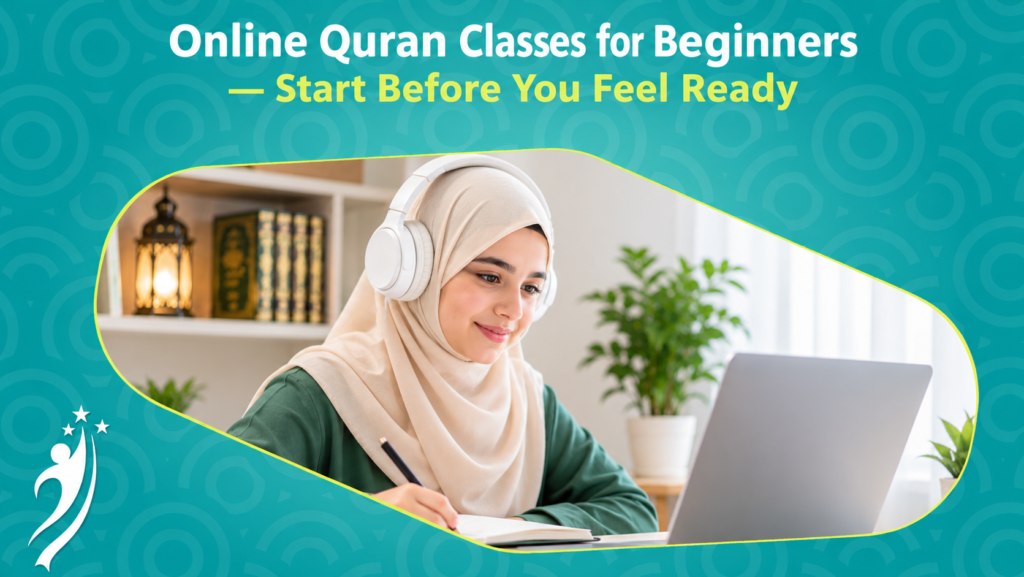
If you are looking for online Quran classes for beginners, you may already be wondering whether you need to prepare before you can even begin.
Perhaps you cannot recognize all the Arabic letters.
Maybe you learned them years ago but cannot join them into words anymore.
You might rely on transliteration, hesitate when opening the Mus’haf, or simply have no idea what your “level” is.
None of those situations disqualifies you from starting.
A beginner class should solve that uncertainty—not expect you to solve it first.
Quick Answer
Online Quran classes for beginners can start from zero Arabic reading ability.
A teacher can first identify what you already recognize, then place you at the first skill you genuinely need—whether that is Arabic letters, vowel marks, connected words, guided Quran reading, or early pronunciation work.
You do not need to know your exact level before registering. The important thing is to begin from the correct starting point rather than jumping into material that is too advanced.
For the full overview of learner types, courses, formats, teachers, and pricing, start with the main Online Quran Classes page.
Online Quran Classes for Beginners Should Remove Guesswork
A beginner’s first problem is often not the Arabic alphabet.
It is uncertainty.
You may be asking:
Do I start with a Qaida?
Should I read directly from the Quran?
Do I need Tajweed immediately?
Am I really a beginner if I already know some letters?
What if I studied before but forgot most of it?
You should not have to diagnose yourself before taking a Quran class.
The better approach is:
show what you can do → identify the first weak skill → begin there
That creates a much cleaner starting point.
The Beginner Entry Map: Where Are You Starting?
“Beginner” covers several different levels.
Use this map to understand where your lessons might begin.
| Your Current Ability | A Likely Starting Focus |
|---|---|
| I do not recognize most Arabic letters | Letter recognition and sounds |
| I know letters individually but lose them inside words | Letter forms and connections |
| I know letters but struggle with Fathah, Kasrah, and Dammah | Short vowels and sound patterns |
| I can sound out letters but cannot read words smoothly | Joining and word reading |
| I can read simple words but not Quran verses confidently | Guided Quran reading |
| I read slowly but make frequent pronunciation mistakes | Reading fluency and early correction |
| I already read Quran fairly well | You may not need a beginner class at all |
That last row matters.
A good beginner program should not keep you in beginner material simply because you selected the word “beginner” on a form.
Your actual reading should decide what comes next.
What You Do Not Need Before Starting
There are several things beginners often believe they must do first.
You Do Not Need to Speak Arabic
Reading Quranic Arabic and speaking Arabic conversationally are different skills.
You can begin learning the Quranic script without already speaking Arabic fluently.
You Do Not Need to Memorize the Alphabet Before Registering
If Arabic letters are your starting point, that can be part of your lessons.
Preparing before class is fine.
But preparation should not become a barrier that delays starting indefinitely.
You Do Not Need to Understand Tajweed Terminology
Words such as Madd, Ghunnah, Ikhfa, or Qalqalah do not need to mean anything to you on day one.
Pronunciation develops alongside reading.
Formal Tajweed concepts can be introduced progressively when they become useful.
You Do Not Need to Know Which Level to Select
“Beginner,” “elementary,” and “intermediate” can mean different things on different websites.
Your teacher needs to hear or see what you can actually do.
That is more useful than a label.
What Should Happen Before a Beginner Is Given a Learning Path?
The teacher needs information.
Not a perfect performance.
For a complete beginner, that may be as simple as checking whether you recognize certain letters and vowel marks.
Someone with previous experience may be asked to read:
- individual letters
- connected words
- a short line
- a few Quranic verses
The purpose is to identify the first skill that is not yet secure.
A useful beginner assessment should leave you with a clearer answer to three questions:
What can I already do?
Where does my reading begin to break down?
What should I work on next?
If you are preparing for that first meeting, use Your First Online Quran Class: What to Prepare Before You Start.
Beginner Does Not Always Mean “Start From Alif”
This is one of the most important decisions in beginner Quran learning.
Imagine someone who recognizes every Arabic letter but cannot join them smoothly.
Starting again by memorizing isolated letters for weeks may waste time.
Another learner may read connected words but consistently guess unfamiliar ones.
They need a different kind of foundation work.
The starting level should be specific enough to solve the actual problem.
That is why a private lesson can be particularly useful at the beginning: the teacher can move quickly through what you already know and slow down where the difficulty actually appears.
Islamic For You’s current paid plans are based on private teacher guidance. The future One-to-One Online Quran Classes page explains how that format works in more detail.
What Will You Actually Study as a Beginner?
The exact sequence depends on your starting point.
A complete beginner may work through skills such as:
- recognizing Arabic letters
- distinguishing similar-looking letters
- learning correct basic sounds
- understanding short vowel marks
- recognizing letters in different positions
- joining letters into words
- reading simple Quranic words
- moving gradually into Quranic text
Someone who already has these foundations may begin further ahead.
The goal is not to complete a checklist as quickly as possible.
It is to make sure the reading foundation is strong enough for the next stage.
For the educational sequence itself, see How to Learn Quran Online Step by Step.
That article owns the full step-by-step learning process.
This page stays focused on choosing and starting beginner classes.
When Does Tajweed Begin for a Beginner?
Tajweed should not feel like a separate mountain waiting after you learn to read.
Correct pronunciation begins early.
But there is also little value in overwhelming a complete beginner with a long list of formal rules before they can comfortably read a word.
A more useful progression is:
read the letter correctly → read the word correctly → apply relevant recitation rules as reading develops
That means beginners can build good pronunciation habits early while formal Tajweed grows alongside their reading ability.
If your main goal is Quran reading and recitation, the Online Quran Reading & Tajweed Program is the relevant course path at Islamic For You.
The “No-Guess Start” Test
Before choosing a beginner Quran class, ask whether the learning experience answers these four questions clearly.
1. Can the Teacher Identify My Real Starting Point?
You should not be placed into material only because of your age or the course name.
2. Will I Read During the Lesson?
Even very early beginners should eventually be producing sounds, identifying letters, combining them, and trying material themselves.
A lesson should not be only explanation.
3. Will Mistakes Be Corrected Before They Become Familiar?
If you pronounce a letter incorrectly several times without feedback, the incorrect version can begin feeling normal.
Early correction matters.
4. Will I Know What to Practise Before the Next Lesson?
“Study Arabic” is not useful homework.
A beginner needs something specific.
For example:
Review these six letters.
or:
Read these three combinations again.
Clarity makes independent practice much easier.
Adults Starting From Zero Need a Different Conversation
Some adult beginners feel embarrassed by material that appears basic.
They may think:
I should have learned this when I was younger.
That thought does not improve your reading.
Starting from the first skill you genuinely need does.
An adult may also learn differently from a child.
Adults often want to understand:
- why a sound is wrong
- what changed in the correction
- how the learning stages connect
- how classes will fit around work and family
If you are an adult beginner, Online Quran Classes for Adults focuses on those wider adult-learning decisions.
Children Starting From Zero Need Active Participation
A beginner child does not simply need “easy material.”
The teacher needs to keep the child involved.
That may mean:
- asking the child to identify a letter
- waiting before giving the answer
- letting them repeat after correction
- changing pace when attention drops
- using shorter tasks when appropriate
The aim is to make the child do more of the learning—not simply watch more of the lesson.
Parents choosing classes for a child should also review Online Quran Classes for Kids.
Women Can Request a Female Quran Teacher
Some beginner women feel more comfortable learning with a female teacher, especially when they are rebuilding confidence in reading aloud.
Islamic For You currently offers male and female teacher options, subject to availability and scheduling.
The future Online Quran Classes for Women page covers female teacher preference and the wider learning considerations for women.
How Long Does It Take to Stop Feeling Like a Beginner?
There is no honest universal date.
One learner begins with zero letter recognition.
Another already knows the alphabet.
Someone else can read words but hesitates constantly.
These students should not be expected to reach independent Quran reading at the same time.
Instead of asking only:
“How many months until I finish?”
look for milestones:
- letters become easier to recognize
- vowel marks stop feeling unfamiliar
- connected words require less decoding
- you rely less on transliteration
- familiar Quranic words become easier
- teacher prompts become less frequent
Our realistic Quran learning timeline explains this distinction in more detail.
How Often Should Beginners Take Quran Classes?
Beginners usually benefit from enough contact with the material that newly learned letters and sounds do not completely disappear between lessons.
But more classes are not automatically better.
You still need enough time to practise what was corrected.
Instead of choosing the largest package immediately, ask:
Do I remember the last lesson?
Did I practise the correction?
Can I sustain this schedule?
Then review How Many Quran Lessons Per Week Do You Need? before choosing your lesson frequency.
Current plans and lesson lengths are listed on the Pricing page.
What Should Beginner Online Quran Classes Cost?
Cost should be considered after you understand the lesson format and frequency you actually need.
A lower monthly price is not automatically better value if:
- the lesson format does not suit you
- you rarely receive useful correction
- the schedule causes repeated cancellations
- you purchase more classes than you can realistically use
Islamic For You’s current pricing varies by lesson duration and weekly frequency and includes private teacher guidance.
Use the Pricing page as the Owner for current fees rather than relying on prices copied into other pages.
Try Two Classes Before Deciding
A beginner often learns more from experiencing a teacher than from reading another ten course descriptions.
Islamic For You currently offers two free trial lessons within one week.
Use those sessions to answer practical questions.
After the First Trial
Ask:
- Did the teacher understand what I already know?
- Was the material appropriate?
- Did I feel comfortable attempting answers?
- Were mistakes explained clearly?
After the Second Trial
Look for continuity:
- Did the teacher remember the previous difficulty?
- Was anything reviewed?
- Did I remember a previous correction?
- Is my next learning step clearer?
The purpose of the trial is not to prove that you are a good student.
It is to discover whether the learning process is a good fit.
Beginner Enrollment Checklist
Before choosing online Quran classes for beginners, make sure you can answer these questions.
Current Level
What is the most difficult reading task you can currently do without help?
Main Goal
Do you want to read the Quran independently, improve pronunciation, or eventually move into another Quran study path?
Lesson Format
Would private teacher attention make it easier to ask questions and receive repeated correction?
Teacher Preference
Do you have a male or female teacher preference?
Weekly Schedule
Which times can you genuinely maintain?
Budget
Which lesson frequency fits both your learning needs and your monthly budget?
Trial
Can you experience the teaching before committing?
At Islamic For You, the answer to that last question is yes.
What Comes After the Beginner Stage?
Being a beginner is a starting point.
It is not your permanent course identity.
Once basic reading becomes more independent, your next goal may be:
stronger Quran reading and Tajweed
→ Online Quran Reading & Tajweed Program
understanding Quranic language
→ Qur’anic Arabic Mastery
studying meanings and Islamic knowledge
→ Online Quran Tafsir & Islamic Studies Program
advanced recitation and Ijazah
→ Sanad & Ijazah Program
Or compare all available options on the Courses page.
The aim is not to stay in beginner material forever.
It is to build enough foundation for the next stage to make sense.
Frequently Asked Questions
Yes. A complete beginner can begin with Arabic letters and basic sounds. Previous Arabic knowledge is not required before starting Quran reading foundations.
Not necessarily before enrolling. A structured Qaida or similar foundational material may be used when appropriate, depending on your current reading ability. The teacher should first identify what you actually need.
Islamic For You’s current paid plans use private teacher guidance. Private lessons can be useful for beginners who need repeated correction and a pace matched to their current ability.
Yes. Adult learners can begin from any level, including Arabic letter recognition. Age does not determine your reading level.
Yes. Children can begin from foundational reading skills when lessons are adapted to their age, attention, and current ability.
There is no fixed duration. Starting level, practice, lesson frequency, pronunciation difficulty, and learning pace all affect the timeline.
Yes. Islamic For You currently offers two free trial lessons within one week before you decide whether to continue with a paid plan.
Start Before You Feel Ready
The strongest online Quran classes for beginners do not ask you to prepare until you no longer look like a beginner.
They give you somewhere appropriate to begin.
You may start with one Arabic letter.
A forgotten reading skill.
A few disconnected words.
Or more ability than you realized.
The first job is simply to find the starting line.
From there, the learning path becomes much clearer.
If you are ready to find your real starting level, request your two free trial classes and begin from the first skill you genuinely need.