
Almost every online Quran teacher profile sounds good.
Qualified. Experienced. Patient. Friendly. Flexible.
Those words may all be true, but they still do not tell you what will happen when you misread a word.
And that is where the real teaching starts.
If you want to know how to choose an online Quran teacher, pay close attention to the first few mistakes you make during a trial lesson.
Does the teacher notice them?
Can they explain what went wrong?
Do they help you correct the mistake—or simply pronounce the correct version for you?
And most importantly, do they notice when the same difficulty appears again later?
Quick Answer
To choose an online Quran teacher, do not judge only by certificates, profile descriptions, years of experience, or a pleasant first conversation.
During a real lesson, watch the first three corrections:
Correction 1: Does the teacher identify the real mistake?
Correction 2: Can they explain it differently if you still struggle?
Correction 3: Do they check later whether you can apply the correction without help?Those three moments can tell you more about how someone teaches than a long list of adjectives on a profile.
If you are still deciding where Quran lessons fit into your wider learning journey, start with Learn Quran Online: A Practical Guide for Beginners, Adults, and Families.
Here, we are answering a narrower question:
How can you tell whether a Quran teacher can actually teach you?
How to Choose an Online Quran Teacher: Start With the First Mistake
A teacher’s recitation may sound beautiful.
That matters.
But being able to recite well and being able to help someone else recite better are not exactly the same skill.
Teaching becomes visible when something goes wrong.
Imagine you read a word incorrectly.
The teacher now has several choices.
They can simply read the correct version and move on.
They can tell you:
“Again.”
Or they can identify what actually happened:
“The letter is correct, but you shortened the vowel.”
Now you know what needs to change.
That difference matters.
Broader educational evidence points in the same direction. The Education Endowment Foundation’s guidance on feedback emphasizes that useful feedback should help learners understand how to improve rather than simply telling them whether something was right or wrong.
So during a trial lesson, do not only listen to how well the teacher reads.
Listen to how well they respond when you do not.
Correction 1: Can the Teacher Find the Real Problem?
This is the first test.
You make a mistake.
What happens next?
Suppose you misread a word.
A useful correction should identify the problem clearly enough that you know what to work on.
Was it:
- the wrong letter?
- an incorrect vowel?
- Makharij?
- Madd length?
- Ghunnah?
- a stopping mistake?
- hesitation while joining letters?
There is a big difference between:
“That was wrong.”
and:
“You are producing ص too lightly. Listen to the difference, then try it again.”
The second correction gives the student somewhere to go.
Watch What the Teacher Does Next
A good correction usually leads to another attempt.
The learner should get an opportunity to use the feedback immediately.
That might look like:
mistake → explanation → demonstration → student repeats → teacher checks
If the teacher constantly corrects mistakes but rarely asks you to try again, you are hearing many corrections without actually practising them.
Correction 2: What Happens When the First Explanation Does Not Work?
This may be an even better teaching test.
Anyone can repeat the same instruction twice.
Teaching becomes more visible when the student still does not understand.
Imagine the teacher says:
“Pronounce it from here.”
You try again.
It is still wrong.
What happens now?
Does the teacher repeat the exact same sentence louder?
Or do they change the explanation?
They might:
- isolate the difficult letter
- compare it with a similar sound
- slow the word down
- demonstrate mouth or tongue position
- give another example
- let you listen before trying again
- temporarily move back to an easier word containing the same sound
The specific technique depends on the difficulty.
What matters is the adjustment.
Good Teaching Is Responsive
A teacher may have a preferred method.
But the student in front of them may not understand that particular explanation.
A useful online Quran teacher notices this and tries another route.
This is especially important for complete beginners.
A learner who has never studied Arabic may not understand technical terminology.
Telling them the name of a Tajweed rule does not automatically help them produce the sound correctly.
The explanation has to meet the learner at their current level.
Correction 3: Does the Teacher Check the Same Skill Again Later?
Now comes the most revealing part.
The student finally pronounces the word correctly.
Good.
But did they learn the correction, or did they simply copy the teacher once?
The lesson continues.
A few minutes later, the same letter or Tajweed pattern appears again.
What does the teacher do?
Ideally, they give the learner a chance to apply the correction independently.
This creates an important distinction:
Can the student repeat the teacher?
versus:
Can the student use the correction when the teacher is no longer modelling it?
The second tells you much more about learning.
A strong teacher begins noticing patterns.
They may say:
“This is the same sound we corrected earlier. Try it before I help you.”
Now the learner has to retrieve and apply the correction.
That is far more useful than moving through the page while the teacher fixes every difficult word for them.
The Three-Correction Test
You can use this during a trial Quran lesson without turning the session into an interview.
Simply observe.
| Moment | What to Watch |
|---|---|
| First mistake | Does the teacher identify exactly what needs changing? |
| Second difficulty | Can the teacher adjust the explanation when you do not understand? |
| Later repetition | Does the teacher check whether you can apply the correction independently? |
If all three happen, you have seen actual teaching.
Not just a teacher profile.
Qualifications Still Matter—but They Need to Match Your Goal
The three-correction test does not mean qualifications are irrelevant.
They matter.
But the relevant qualification depends partly on what you want to study.
Someone teaching advanced Tajweed or preparing a student for Ijazah needs a different depth of specialization from someone introducing Arabic letters to a complete beginner.
Before enrolling, understand:
- what the teacher has studied
- what they are qualified to teach
- whether their experience matches your current goal
- whether they have taught learners at your level before
Do not stop at the word:
“Certified.”
Ask what it means.
At the same time, do not assume that a long list of qualifications automatically means the teacher communicates well with every learner.
Subject knowledge and teaching ability work together.
You need both at the level appropriate to your goal.
Listen to Who Talks More
This is one of the simplest things to notice during a Quran reading lesson.
Who is doing most of the reading?
For a lecture or Tafsir lesson, the teacher may naturally speak more.
But if the goal is improving your Quran reading, the teacher needs to hear you.
A trial Quran reading class where the teacher spends most of the session describing their method may tell you very little about how they will actually correct your recitation.
You should normally have enough opportunity to:
- read
- make mistakes
- receive correction
- repeat
- try again
Without that, you have mainly tested the teacher’s presentation skills.
Not their response to your reading.
Notice Whether the Teacher Learns Something About You
A good trial should not only teach you something.
It should also teach the teacher something about you.
By the end of the session, can they describe your starting point with some specificity?
Compare:
“You are intermediate.”
with:
“You read connected Quranic text comfortably, but we need to work on two recurring pronunciation issues and your Madd consistency.”
The second gives you a much clearer learning direction.
A teacher does not need to discover everything in one short lesson.
But they should begin forming a picture of:
what you can already do → what is getting in the way → what should come next
That is much more useful than assigning a generic level.
If you are preparing for your first assessment and want to know what information, equipment, and expectations to bring into the session, see Your First Online Quran Class: What to Prepare Before You Start.
Be Careful With a Trial Lesson That Feels Too Perfect
A trial lesson can sometimes feel unusually easy.
Every answer is praised.
Very few mistakes are corrected.
The material is comfortable.
You finish feeling confident.
That experience may be pleasant, but ask yourself:
Did the teacher actually hear enough of my reading to understand my level?
A useful assessment does not need to make you uncomfortable.
But it should reveal something.
For example:
“Your reading foundation is stronger than you thought, but these two sounds need focused work.”
or:
“Before beginning Tajweed rules, we should strengthen how you join words.”
You should ideally know more about your learning needs after the trial than before it.
What If You Are Choosing an Online Quran Teacher for Your Child?
Parents have an additional challenge.
A child may enjoy the teacher, but enjoyment alone does not tell you whether useful learning is happening.
At the same time, technically accurate teaching is not enough if the child becomes too anxious to participate.
Watch the interaction.
Does the Teacher Wait for the Child to Answer?
Some adults unconsciously answer their own questions after one second.
Children need time to think.
Does the Teacher Correct Without Embarrassing the Child?
The child should understand that mistakes are part of the lesson.
Constant frustration or visible fear of answering can reduce participation.
Can the Teacher Regain Attention?
Children become distracted.
The question is not whether distraction ever happens.
Watch how the teacher responds.
Do they:
- shorten the task?
- ask the child to read?
- switch to something more active?
- redirect calmly?
Or does the lesson simply continue while the child stops participating?
Do You Know What the Child Should Review?
Parents should not have to guess.
A short, clear instruction such as:
“Please review these three lines before Thursday.”
is much more useful than:
“Practise Quran.”
Once lessons begin, the parent’s role is not to become a second teacher. We cover that distinction in How Parents Can Support a Child Learning Quran Online Without Becoming the Second Teacher.
Do You Need the Same Quran Teacher Every Week?
Usually, continuity has real practical value.
A teacher who regularly works with you begins recognizing:
- recurring pronunciation difficulties
- what has already been explained
- what you tend to forget
- your reading pace
- which corrections are becoming more stable
If teachers change constantly, some of that context has to be rebuilt.
That does not mean changing teachers is always bad.
Sometimes the match is simply wrong.
Sometimes another teacher has more relevant expertise.
But it is useful to know before enrolling whether:
you are choosing a specific teacher
or:
you are joining a system where tutors may rotate
Those are different experiences.
Teacher Fit Is Not the Same as Teacher Quality
A capable teacher can still be the wrong match for a particular student.
An excellent teacher of advanced Tajweed may not enjoy teaching very young beginners.
A teacher who works wonderfully with children may not be the best choice for an adult seeking detailed advanced recitation correction.
A learner may also need explanations in a particular language.
So do not ask only:
“Is this a good Quran teacher?”
Ask:
“Is this teacher good for the problem I need help solving?”
That small change makes the decision much easier.
Private or Group Format Can Change the Teaching Experience
The same teacher may teach differently in a private class and in a group.
In one-to-one lessons, they can spend more time responding to one learner’s mistakes.
In groups, teacher attention and reading time are shared.
Neither format is automatically good or bad.
But the format should match the kind of feedback you need.
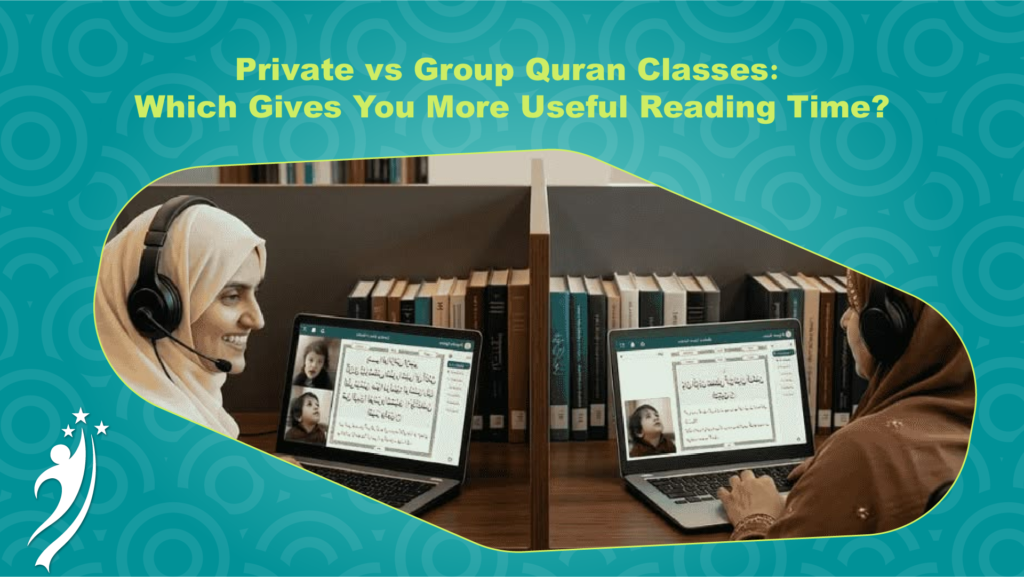
We explored that separately in Private vs Group Quran Classes: Which Gives You More Useful Reading Time?.
Red Flags That Matter More Than a Perfect Teacher Profile
Online reviews can provide useful context.
But the lesson itself can reveal more immediate problems.
Watch for these patterns.
Mistakes Are Regularly Ignored
Not every tiny issue needs to interrupt every line.
But repeated mistakes should not simply pass unnoticed.
Every Correction Sounds the Same
“Again.”
“Again.”
“Again.”
If repetition is not solving the problem, the explanation may need to change.
The Teacher Gives the Answer Too Quickly
Students need opportunities to think and try.
If the teacher constantly supplies the correct reading before you attempt it, it becomes difficult to know what you can actually do independently.
There Is No Clear Next Step
By the end of an assessment, you should have some idea of what you need to work on.
You Cannot Comfortably Ask Questions
You may study with this person repeatedly.
Communication matters.
A Better Question Than “Did I Like the Teacher?”
After the trial, do not decide only from the feeling of the conversation.
Ask:
What Mistake Did They Notice?
Can you name one?
How Did They Help Me Correct It?
Was the explanation understandable?
Did I Get Another Chance to Apply the Correction?
Did the teacher check again later?
What Did They Say I Should Work on Next?
Was it specific?
Would I Feel Comfortable Making Mistakes in Front of This Person Every Week?
Because you will.
That final question matters more than whether the trial conversation was impressive.
Frequently Asked Questions
To decide how to choose an online Quran teacher, check relevant qualifications but also observe real teaching. During a trial, watch whether the teacher identifies mistakes accurately, explains corrections clearly, changes the explanation when you struggle, and later checks whether you can apply the correction independently.
That depends on the level and subject being taught. For advanced recitation or Ijazah study, relevant specialist qualifications become particularly important. At any level, understand what the teacher has studied and whether their expertise matches your goal rather than relying only on vague claims such as “certified.”
A useful Quran trial lesson should include actual reading or assessment, not only a conversation about the course. The teacher should begin identifying your current level, correct real mistakes, and give you a clearer idea of what you should work on next.
Watch how your child participates. A suitable teacher should hear the child’s real level, give understandable correction, allow time to answer, redirect attention when needed, and communicate clearly about what should be reviewed between lessons.
Not automatically. Experience is useful, but relevance matters too. A teacher with many years of advanced recitation teaching may not be the best match for a young beginner. Look for experience with learners who have needs similar to yours.
Choose the Teaching, Not the Profile
If you want to know how to choose an online Quran teacher, the teacher’s profile is only the beginning.
Qualifications tell you what someone has studied.
Experience tells you what kind of learners they may have taught.
A trial lesson tells you something different:
what happens when you need help.
Watch the first mistake.
Then watch what happens when the first explanation does not work.
Then notice whether the teacher remembers the difficulty and checks it again later.
Those three corrections can reveal whether the lesson is simply moving forward—or whether the teacher is actually paying attention to how you learn.
If Quran reading, pronunciation, and Tajweed are your main goals, explore the Online Quran Reading & Tajweed Program and use the initial lesson to judge the teaching approach against the same standards in this guide.