
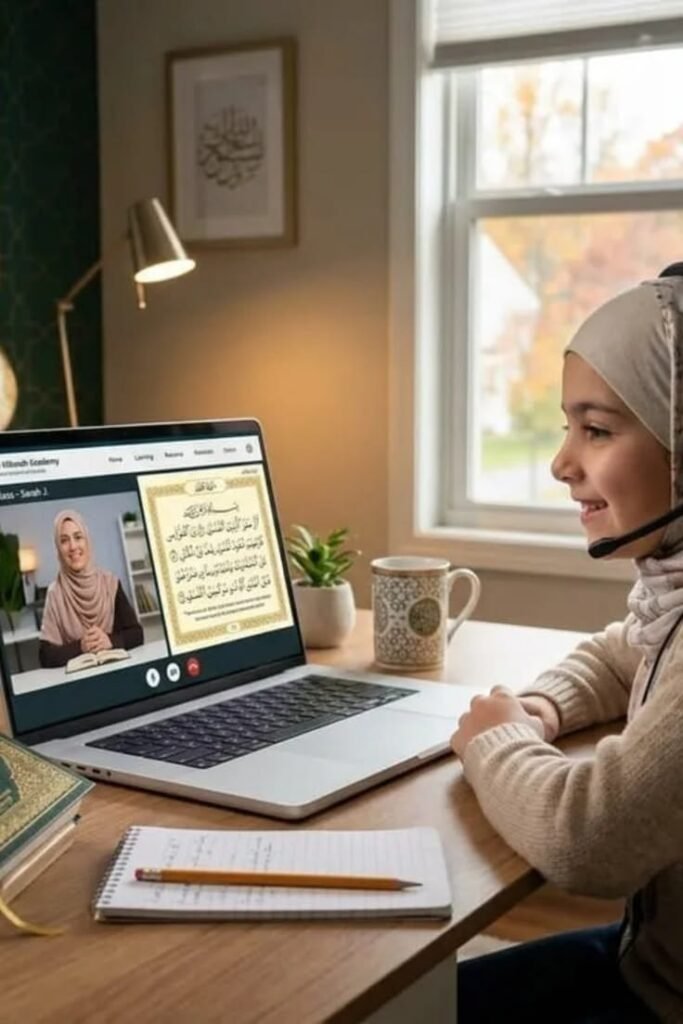
Your first online Quran class should not feel like an exam.
You do not need perfect Arabic, a special study room, expensive equipment, or hours of preparation before you join.
In most cases, you need something much simpler: a working device, a quiet enough place to listen and read, your learning material, and an honest idea of what you can and cannot currently do.
The purpose of the first lesson is not to prove how much Quran you already know.
It is to help the teacher understand where you should begin.
Quick Answer
Before your first online Quran class, prepare:
- a device with a working microphone and camera
- a stable internet connection
- a quiet place where you can read aloud
- the Quran or learning material your teacher asks you to use
- any information about previous Quran or Arabic study
- one or two clear goals you want help with
Most importantly, do not hide your actual level. A useful first lesson starts from where you are now.
If you are still looking at the bigger picture of online Quran learning, start with our Learn Quran Online: A Practical Guide for Beginners, Adults, and Families.
Here, we will focus only on getting ready for that first class.
1. Check Your Device Before the Lesson Starts
You do not need complicated technology.
A laptop, tablet, or even a suitable phone can work for an online Quran lesson if the teacher can hear and see you clearly.
Before class, check:
- Is the device charged?
- Does the microphone work?
- Can you hear audio clearly?
- Does the camera work if the lesson uses video?
- Is the internet connection reasonably stable?
- Can you open the meeting link?
Do this before the scheduled lesson rather than discovering a microphone problem after the class has already started.
Headphones Can Help, but They Are Not Always Necessary
If the room is noisy or your device creates an echo, headphones may make it easier to hear pronunciation clearly.
But they are not a requirement for every learner.
The goal is simple:
You need to hear the teacher clearly, and the teacher needs to hear you clearly.
That matters much more than having expensive equipment.
2. Choose a Place Where You Can Read Aloud Comfortably
Online Quran lessons are interactive.
You will probably need to read, repeat sounds, answer questions, and try a correction several times.
That becomes difficult if you are in a place where you feel uncomfortable speaking.
You do not need complete silence.
You simply need somewhere where normal conversation is possible without constant interruptions.
For an adult, that might be a desk in a bedroom or a quiet corner of the house.
For a child, it may be somewhere a parent can remain nearby without distracting the lesson.
Try to avoid:
- a television playing beside you
- people constantly walking through the room
- taking the class while travelling
- joining from a place where you cannot comfortably read aloud
- having several devices making noise around you
The space does not need to look impressive on camera.
It needs to help you concentrate.
3. Have Your Quran or Learning Material Ready
Do not spend the first ten minutes of your lesson searching for the page you need.
Ask in advance whether the teacher expects you to use:
- a printed Mus’haf
- a digital Quran
- a Qaida or beginner reading book
- worksheets
- another course-specific resource
If you already use a particular Mus’haf or beginner book, keep it nearby even if you are not sure whether it will be used.
It may help the teacher understand what you have studied before.
Printed or Digital Quran?
Either can work.
Some students prefer a printed copy because it is easier to follow with a finger and keep attention on one page.
Others are comfortable reading from a tablet or shared screen.
You do not need to make this a major decision before your first lesson.
Use what allows you to read comfortably unless your teacher asks for something specific.
4. Be Ready to Explain What You Have Studied Before
This does not need to be a formal academic history.
The teacher simply needs enough information to avoid guessing your level.
You might say:
“I learned Arabic letters as a child, but I have forgotten many of them.”
Or:
“I can read the Quran, but I know I make Tajweed mistakes.”
Or:
“My child completed part of a Qaida with another teacher.”
Or simply:
“I have never studied Arabic or Quran reading before.”
All of these are useful answers.
What makes the first lesson harder is saying that you are an “intermediate reader” when neither you nor the teacher really knows what that means.
Specific information is much more helpful than labels.
5. Do Not Study Extra Just to Look Better in the Assessment
This may sound strange, but it matters.
If the teacher asks you to read something during the first class, you do not need to practise that exact passage repeatedly beforehand simply so you can perform well.
The point is not to receive a high score.
The teacher is trying to see what happens when you read naturally.
If you struggle with connected letters, that is useful information.
If you confuse certain sounds, that is useful information.
If you read well but pause in unusual places, that is useful information too.
The more accurately the teacher sees your real level, the easier it is to place you in suitable material.
You are not failing an assessment by making mistakes.
The mistakes are part of the assessment.
6. Think About Why You Want to Learn
You do not need a five-year learning plan.
But it helps to know what brought you to the class.
For example:
- “I want to learn to read the Quran from the beginning.”
- “I can read, but I want to improve Tajweed.”
- “I want to stop depending on transliteration.”
- “I want my child to become more confident reading Quran.”
- “I learned years ago and want to start again.”
- “I want my recitation corrected properly.”
This gives the teacher context.
Two students may make similar reading mistakes but have different goals.
One may simply want to read more accurately.
Another may eventually want to pursue advanced recitation.
The first lesson does not need to solve the whole journey, but the teacher should understand the direction you want to move in.
7. Expect to Read Something During the First Class
A first Quran lesson should normally involve more than introductions.
If you already read Arabic, the teacher may ask you to read a few lines or verses.
If you are a beginner, you may be shown letters, vowel marks, or simple combinations.
This helps reveal things that are difficult to discover through conversation alone.
For example, someone may say:
“My reading is okay but my Tajweed is weak.”
After listening, the teacher may find that Tajweed is not the first issue at all. The learner may actually need help with several letter sounds.
Or the opposite may happen.
A student who lacks confidence may read more accurately than they expected.
That is why hearing the student is important.
8. Ask Questions When Something Is Unclear
A first class is also your chance to understand how the learning process will work.
You do not need to arrive with a long questionnaire.
A few practical questions may be enough:
- What should I practise after this lesson?
- What material will we use?
- What should I focus on first?
- Will you correct pronunciation as I read?
- Is there anything I should review before the next class?
Notice what these questions have in common.
They are about your learning.
They are much more useful during the first lesson than trying to cover every possible question about the entire course.
9. Parents: Prepare the Child, but Do Not Turn It Into a Test
For children, the few minutes before the lesson can affect how the class begins.
Try not to introduce the session with warnings such as:
“Make sure you answer everything correctly.”
or:
“The teacher is going to test you.”
That can make a normal first lesson feel much more serious than it needs to.
Instead, keep the explanation simple:
“Your teacher wants to see what you already know so they know where to start with you.”
Make sure the child has:
- the device ready
- any books or worksheets nearby
- water if needed
- a comfortable seat
- fewer distractions around them
Then allow the teacher to interact with the child.
You do not need to answer every question for them.
The teacher needs to hear what the child knows independently.
We will deal with the parent’s role throughout ongoing Quran learning separately in:
How Parents Can Support a Child Learning Quran Online
What You Do NOT Need Before Your First Quran Lesson
Many learners delay starting because they think they need to prepare more than they actually do.
You do not need to:
Know the Arabic Alphabet Already
If you are a complete beginner, that is where your learning can begin.
Understand Tajweed Terminology
You do not need to know words such as Ghunnah, Ikhfa, or Idgham before attending your first class.
Speak Arabic
Reading Quranic Arabic and speaking conversational Arabic are different goals.
Buy Several Books
Wait until you know what learning material you will actually use.
Practise for Hours Before the Assessment
Let the teacher see your normal reading level.
Know Exactly Which Course Level You Need
That is one of the things an initial assessment can help clarify.
First Online Quran Class Checklist
Use this shortly before your lesson.
| Check | Ready? |
|---|---|
| Device charged | ☐ |
| Microphone tested | ☐ |
| Audio working | ☐ |
| Internet connection checked | ☐ |
| Meeting link available | ☐ |
| Quran or learning book nearby | ☐ |
| Quiet study space ready | ☐ |
| Previous learning details in mind | ☐ |
| Main learning goal clear | ☐ |
| A notebook or way to record homework available | ☐ |
That is enough.
You do not need to turn preparation into another course before the course begins.
What Should Happen by the End of the First Lesson?
Do not expect to understand your entire learning journey after one meeting.
A useful first class should give you something more practical:
a clearer starting point.
By the end, you should ideally understand things such as:
- approximately where your reading level is
- what your main difficulty is right now
- what material you will begin with
- what you should practise before the next lesson
- what the next immediate learning goal looks like
That is much more useful than being told only that you are “beginner,” “intermediate,” or “advanced.”
You want to leave knowing:
What am I working on next?
Frequently Asked Questions
Usually, you need a device with working audio, stable internet, a reasonably quiet study space, and any Quran or learning material requested by your teacher. It also helps to know your previous learning experience and main goal.
Not necessarily. A tablet or suitable phone may work as well, although a larger screen can make reading and following shared material easier.
You may be asked to read letters, words, or Quranic text so the teacher can understand your current level. This is better viewed as an assessment than an exam.
That is fine. Tell the teacher clearly that you are starting from zero. Your first lessons can begin with Arabic letters, their sounds, and basic reading foundations.
That depends on the child’s age and independence. Younger children may need help joining the lesson and staying organised, but parents should also give the teacher enough space to hear what the child can do without constant prompting.
Your First Lesson Is a Starting Point, Not a Performance
You do not need to impress your teacher in your first online Quran class.
You need to give them an honest picture of where you are.
Bring the basic equipment.
Prepare a suitable place.
Have your learning material nearby.
Explain what you have studied before.
Then read as naturally as you can.
A good first lesson should reduce uncertainty rather than create more of it.
You should leave with a clearer idea of what you need to work on next—and that is enough for day one.
If your goal is to begin Quran reading or improve your recitation and Tajweed, you can explore the Online Quran Reading & Tajweed Program and use the trial option available through the course to begin with an assessment of your current level.